China Top 10 Animal Print Wall Art Manufacturers?

Time:2026-11-22 Author:Sophia
0%

China’s wall-art sector serves buyers seeking visual character, consistent production, and dependable delivery. Animal Print Wall Art ranges from framed leopard studies to monochrome zebra canvases and hand-finished wildlife illustrations. The details matter: print sharpness, color consistency, frame joints, packaging, and the surface texture buyers can actually see.

Market reports offer context, but not a ready-made supplier ranking. Grand View Research valued the global home décor market at approximately US$960 billion in 2023; this broad category includes far more than wall art. Mordor Intelligence’s Wall Art Market analysis provides a closer category lens, yet neither report independently verifies individual factory performance. That distinction matters. A large market does not guarantee a reliable manufacturer.

This guide examines ten China-based manufacturers through practical criteria: product range, customization options, materials, production capabilities, quality-control information, and export experience. Buyers should request current samples and confirm specifications before placing substantial orders. A glossy catalog can hide uneven printing. Small flaws count.

The companies below are presented as candidates for comparison, not as a universal ranking. Manufacturing strengths change, and public information may be incomplete. That limitation deserves attention. Use the profiles to build a shortlist, then verify claims directly with each supplier. A sample in hand often answers what a sales page cannot.
China Top 10 Animal Print Wall Art Manufacturers?

Define Animal-Print Wall Art: Motifs, Materials, Sizes, and Print Methods

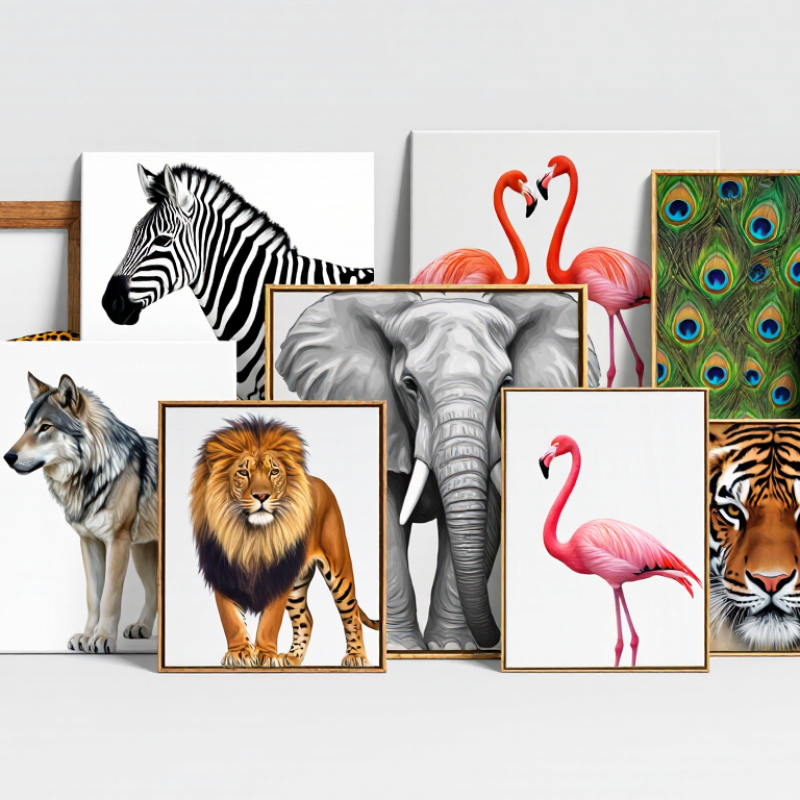
Animal-print wall art borrows visual patterns from animal coats, feathers, or scales. Common motifs include leopard spots, zebra stripes, tiger markings, and snakeskin textures. Some designs reproduce natural markings closely; others simplify them into bold shapes or repeat patterns. The distinction is not always neat. A stylized print may suggest an animal without depicting one directly.

Materials affect appearance and handling. Canvas softens fine details, while coated paper can show crisp edges and strong contrast. Wood panels add visible grain, which may subtly alter the image. Check the stated dimensions before choosing a piece: a small print suits a narrow wall, while a larger format needs enough surrounding space. Measure the wall, not just the frame.

Print methods also shape the result. Inkjet printing can reproduce detailed gradients, while screen printing often produces flatter areas of color. In either case, inspect sample images for sharp edges, balanced tones, and consistent pattern scale. A leopard motif enlarged too much can look unlike its source; reduced too far, its spots may merge. That trade-off is easy to overlook. Ask about surface finish and care instructions, since glare and dust can change how the artwork looks over time.

Set Quality Benchmarks: 300 PPI Output, Color Control, and Substrates

For animal print wall art, 300 PPI is a useful benchmark, not a promise of sharp results. Check the image dimensions at the intended print size before production. A 12-by-16-inch print needs about 3,600 by 4,800 pixels to reach 300 PPI. Then inspect whiskers, feather edges, and fine fur at actual size. Small details matter.

Color control needs more than a bright monitor. Use calibrated displays and consistent print settings, then compare a physical proof under neutral lighting. Check warm browns, deep blacks, and subtle spots; these can shift between screens and printed materials. A screen preview helps, but it is not enough. Even a careful workflow can miss a slight color cast, so document approved settings and review samples regularly.

Substrates affect both appearance and durability. Smooth matte paper can preserve crisp markings, while textured canvas may soften tiny details and add visible grain. Ask manufacturers for samples using the same image and finish planned for the final order. Compare color, texture, and edge definition side by side. The surface changes everything. I would not assume one substrate suits every animal pattern; that shortcut deserves a second look.

Animal Print Wall Art: Quality Benchmarks

Typical print-resolution planning tiers—not manufacturer rankings or test results.

How to read this chart: 300 PPI is a useful target for fine-detail prints viewed at close range. Lower resolutions can be appropriate for larger works viewed from farther away. For color control, specify an agreed ΔE00 tolerance and request a physical proof. Compare substrates by material and finish, such as paper, canvas, or wood panel, rather than assuming one option suits every artwork.

Verify Factory Credentials: ISO 9001, FSC Claims, and Export Readiness

When comparing China’s top 10 animal-print wall art manufacturers, verify documents against the actual production site. The ISO Survey 2022 recorded 1,265,216 ISO 9001 certificates worldwide. That figure shows the standard’s reach, not a supplier’s product quality. Check the certificate number, issuing body, validity dates, factory address, and scope. Ask how complaints, color variation, and print defects are recorded. A polished certificate folder can still leave practical questions unanswered.

For paper-based prints or wood-framed art, verify any FSC claim in the FSC certificate database. FSC’s 2023 facts and figures report more than 160 million hectares of certified forest worldwide, but that does not prove a specific artwork uses certified material. Confirm the supplier’s chain-of-custody scope and whether the quoted product is covered. Export readiness also means consistent carton dimensions, moisture protection, accurate packing lists, and experience preparing shipment documents. Request a redacted sample set. Details matter.

Tips: Match the legal factory name and address across certificates, invoices, and audit records. Request a pre-shipment sample showing the final print, frame, and packaging. Test barcode readability and carton strength before approving a large order. A small mismatch may be fixable; repeated mismatches deserve another look.

Compare China’s Top 10 Suppliers by OEM/ODM, MOQ, Capacity, and Lead Time

Comparing China’s animal print wall art suppliers means looking beyond catalog images. Ask whether each factory offers OEM, ODM, or both. OEM usually follows supplied artwork and dimensions; ODM may include design adaptation, color matching, and sample development. Request a physical proof on the intended canvas, paper, or panel. Leopard spots can shift noticeably between screen and print.

MOQ varies with format, material, and finishing. A supplier may accept a small trial order for standard prints but require larger quantities for custom sizes or framed sets. Confirm whether MOQ applies per design or across a mixed order. Small details matter. Ask for the daily or monthly capacity for your exact product, not the factory’s total output across unrelated goods.

Lead time should include sampling, production, inspection, and packing. Request separate estimates for each stage, plus a realistic peak-season schedule. Compare packaging strength too: corner protectors and moisture barriers can reduce damage during shipping. Numbers can flatter. A polished capacity sheet does not prove consistent color or careful handling, so review dated samples and inspection records where available. Suppliers’ quoted terms can change with artwork approval, material availability, and order size; record those assumptions before comparing offers.

Rank Shortlisted Manufacturers by Sample Quality, Pricing, and Defect Rates

Rank shortlisted manufacturers using the same artwork, dimensions, material, finish, and packaging requirements. This makes sample quality and quoted prices easier to compare. Inspect each sample in daylight and under warm indoor lighting. Look for accurate animal-print colors, clean edges, even coating, and sharp details in fur, feathers, or scales. Check the reverse side too; uneven mounting or curled corners can signal handling problems.

Sample quality might carry 40 percent of the score, defect performance 35 percent, and comparable pricing 25 percent. These weights reward consistency without ignoring cost. Request a small pilot run and record defects as rejected pieces divided by inspected pieces. Note issues such as scratches, color shifts, bubbles, and damaged corners. A polished sample alone is not enough. Ask how the supplier checks full production batches.

Compare prices only when specifications match. Include printing, finishing, protective packing, and any setup charges in the quoted total. A lower quote can become less attractive if it excludes corner protection or uses a thinner substrate. Keep dated photos and a simple inspection sheet for every sample and pilot batch. Some judgments, especially color richness, remain subjective. That is worth admitting. Review the evidence again before finalizing the ranking.

FAQS

What does animal-print wall art depict?

It uses patterns inspired by coats, feathers, or scales. Common examples include leopard spots and zebra stripes.

How do materials affect the artwork’s appearance?

Coated paper can keep edges crisp. Canvas softens fine details, while wood may show grain through the image.

How should I choose the print size?

Measure the wall and allow space around the artwork. A small print can suit a narrow wall; large formats need more room.

Is 300 PPI enough to guarantee a sharp print?

No. It is a useful benchmark, not a promise. Check image dimensions and inspect fine details at actual print size.

What image dimensions suit a 12-by-16-inch print at 300 PPI?

Aim for about 3,600 by 4,800 pixels. Then inspect details such as whiskers and feather edges.

How can I check printed colors before production?

Compare a physical proof under neutral lighting. Look closely at warm browns, deep blacks, and subtle spots.

Which print method preserves gradients or bold shapes?

Inkjet printing can reproduce detailed gradients. Screen printing often creates flatter color areas. Results still depend on the design.

What should I check in a sample?

Compare color, texture, and edge definition using the planned image and finish. A slight color cast can still slip through.

Can one surface work for every animal pattern?

Not necessarily. Smooth matte paper may suit crisp markings, while textured canvas can soften tiny spots. That choice deserves a second look.

Conclusion

This guide explains how to evaluate Animal Print Wall Art, from popular wildlife-inspired motifs and suitable materials to common sizes and printing methods. It outlines practical quality benchmarks, including 300 PPI output, consistent color reproduction, and substrate selection, so buyers can assess whether products are suited to their intended use. It also describes how to check factory credentials, review ISO 9001 and FSC-related claims, and confirm a supplier’s experience with export orders.

The comparison framework focuses on ten Chinese suppliers and considers their OEM/ODM capabilities, minimum order quantities, production capacity, and estimated lead times. Rather than relying on specifications alone, buyers are encouraged to compare samples for image clarity, color accuracy, finish, and overall consistency, then weigh pricing against reported defect rates. These steps provide a structured way to shortlist manufacturers and make a more informed sourcing decision.

Sophia

Sophia

Sophia is a dedicated marketing professional with an exceptional depth of knowledge about her company's products and services. With a keen understanding of market trends and customer needs, she crafts insightful blog posts that not only inform but also engage readers, enriching the company’s online......